
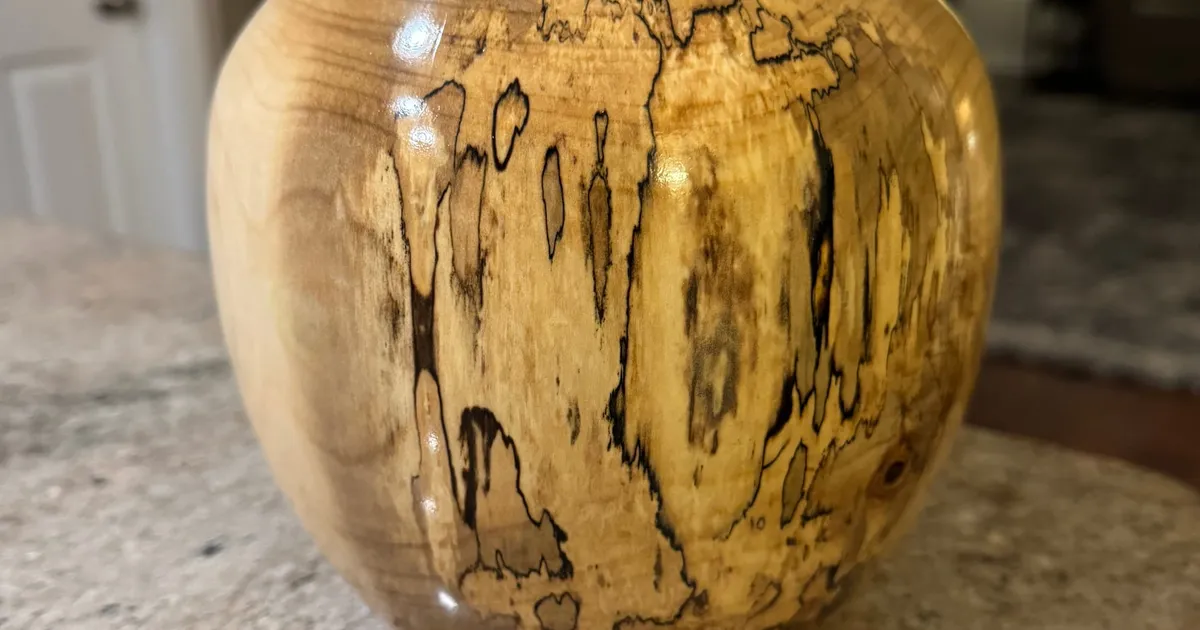
What is Spalted Wood? A Woodturner's Guide to Nature's Most Dramatic Figure
If you’ve ever picked up a wood bowl and noticed dramatic black lines weaving through light-colored grain — as if someone drew on the wood with a fine pen — you were looking at spalted wood. It’s one of the most visually striking figures in all of woodturning, and it happens entirely without human intervention.
Here’s what’s actually going on inside that wood, and why it matters when you’re buying or turning a piece.
What Causes Spalting?
Spalting is the result of fungal activity inside a dead or dying tree. When a log falls or a branch dies, fungi move in to begin breaking down the wood’s cellular structure. Different fungal colonies compete for territory within the log, and as they do, they leave behind several types of distinctive markings:
Zone lines are the most prized. These are the sharp, dark (often black or dark brown) boundary lines that appear where two different fungal colonies meet. Each colony lays down a chemical boundary to defend its territory — and that boundary mineralizes into the wood as a permanent, inky mark. No two zone line patterns are ever the same, which is a large part of why spalted pieces are so collectible.
White rot is a second type of spalting where fungi bleach the wood’s lignin, leaving behind soft, creamy white areas with a slightly different texture. White rot is beautiful but structurally tricky — heavily white-rotted sections can be punky and unstable on the lathe.
Pigment spalting produces larger areas of color — blues, greens, grays — from specific fungal species. This is rarer and often the most dramatic. Some of the most striking pieces I’ve turned have had both zone lines and broad color sections from pigment spalting working together.
Why Woodturners Love It
The appeal is the unpredictability. You can’t order spalted maple the way you order a clear, knot-free board. Each piece of spalted wood is a one-time collaboration between a specific log, a specific set of fungal species, and a specific set of environmental conditions — temperature, moisture, time. Cut the log open and you discover something that’s never existed before and never will again.
For turners, that means every blank is a mystery. The zone lines you see on the end grain give you hints, but the full pattern only reveals itself as you remove material on the lathe. I’ve opened up pieces expecting modest figure and found stunning, dense zone line networks — and I’ve done the opposite too.
The Challenges of Turning Spalted Wood
Spalting is beautiful, but it comes with real technical challenges that a maker has to manage carefully.
Stability varies. A lightly spalted blank — where the fungal process has barely begun — turns almost like normal wood. A heavily spalted blank may have sections that are soft, punky, or crumbly. Experienced turners stabilize punky sections with thin cyanoacrylate (CA) glue before turning, which wicks into the fibers and hardens them enough to cut cleanly.
Dust is a legitimate health concern. The fungal spores in spalted wood are not something you want in your lungs. Proper respiratory protection — a half-face respirator with P100 filters at minimum — is non-negotiable when turning spalted species. I use a Microclimate Air3 powered respirator in my shop for all turning, but especially for anything with significant spalting.
Finishing requires care. Because spalted sections are more porous than healthy wood, finishes absorb unevenly. A heavy film finish applied carelessly can look blotchy or plasticky. Penetrating oils like polymerized tung oil are often the best choice — they saturate the fibers rather than sitting on top, and they make those zone lines pop with a depth that a surface finish can’t replicate.
What Makes a Quality Spalted Piece?
When you’re looking at a finished spalted bowl or vessel, here’s what to pay attention to:
Crispness of the zone lines. Sharp, well-defined black lines indicate the wood was harvested at the right time — after meaningful spalting developed but before the wood became too punky to turn well. Fuzzy or indistinct lines can mean the wood was over-spalted and may have had structural compromises.
Wall consistency. Spalted wood is harder to turn to consistent thickness because hardness varies across the piece. Even wall thickness throughout a bowl reflects real skill and patience.
Finish quality at the zone lines. The zone lines absorb finish differently than surrounding wood. Look for smooth, even sheen across the full surface, not dull patches or raised grain around the dark lines.
No filled cracks that dominate the piece. Some crack-filling is normal and honest. Large cracks that have been clumsily filled suggest the blank had stability problems the maker couldn’t fully resolve.
Spalted Species at Turning Bytes
Most of my spalted work is in maple and birch — both common in Northeast Ohio and both prone to dramatic zone line patterns when spalted properly. Maple in particular produces some of the crispest zone lines of any species, against its naturally light, creamy background.
Browse all my spalted maple pieces: Maple turning projects →
For a close look at bold zone lines finished with polymerized tung oil, see this Spalted Maple Art Bowl → — a 10×6 inch soft maple piece where the spalting does the heavy lifting.
Interested in a custom piece with similar character?
I take a limited number of commissions each month to ensure every piece receives the attention it deserves. Let's discuss your custom commission