
Wood Species for Turning: Cherry, Maple, Walnut & Ash Compared
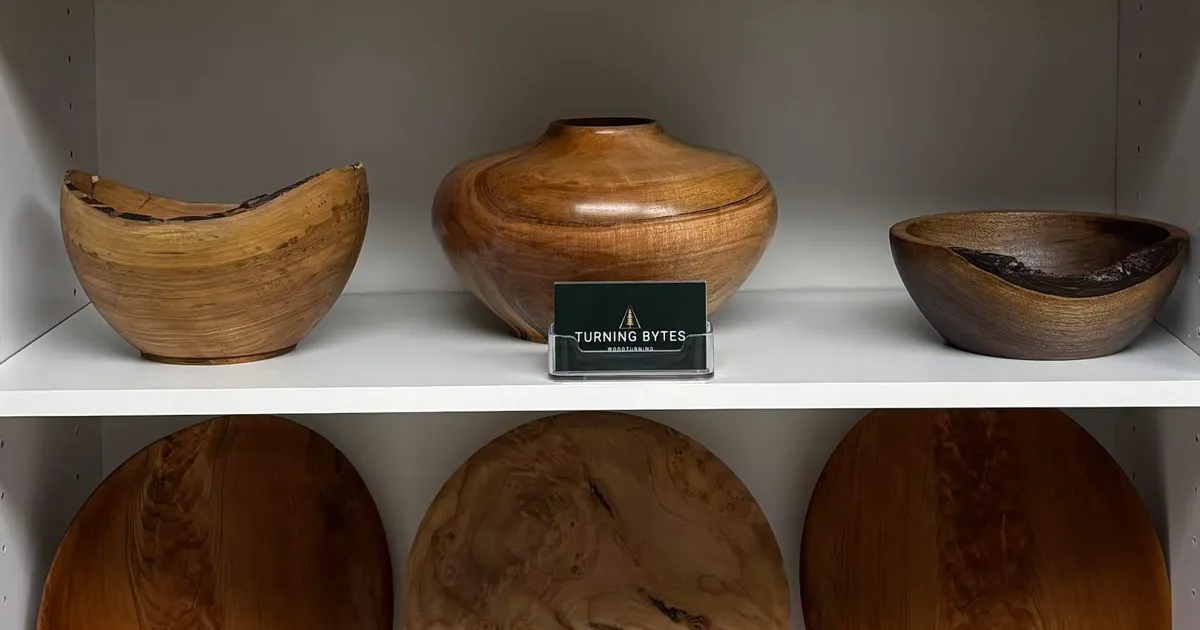
When someone picks up one of my bowls and asks what wood it is, that question usually opens into a longer conversation — about how the species behaves on the lathe, how the color will change over time, whether it’s food safe, and what makes it suited to a bowl versus a vase versus a hollow form.
This is a guide to the four species I turn most: cherry, maple, walnut, and ash. Each one has a distinct personality, and understanding that personality helps you choose a piece you’ll still love in ten years.
Cherry
Cherry is the wood I reach for most often, partly because it’s abundant in Northeast Ohio and partly because it rewards patience in a way no other species does.
Appearance. Fresh-turned cherry is a pale peachy-pink — almost underwhelming when you first see it. Then light hits it. Over the first few months after finishing, cherry undergoes a transformation called oxidation: the surface deepens to a rich reddish-brown, then to a warm amber that intensifies for years. A cherry bowl that looks modest on day one is a deeply beautiful object by year three. Buying a cherry piece is buying something that keeps getting better.
Grain character. Cherry has a fine, even grain with a natural luster that doesn’t need much help from a finish. It’s relatively free of dramatic figure — you won’t find the wild patterns of spalted maple here — but that calm grain is exactly what makes it elegant rather than busy. Some cherry logs produce subtle curl or ray fleck, which catches light beautifully under the right finish.
On the lathe. Cherry is a pleasure to turn. It’s in the medium-hardness range (about 950 on the Janka scale), cuts cleanly with sharp tools, and sands to a silky surface without much effort. It’s a forgiving species, which is partly why I practice new techniques on cherry before moving to more demanding material.
Finishes. Cherry takes almost anything well. I most often use polymerized tung oil or Tried & True Varnish Oil, both of which enhance the natural luster without obscuring the grain. For food-contact pieces, either of those fully-cured options is an excellent choice.
Browse my cherry turning projects → — including this Artisan Cherry Wood Bowl → where Waterlox brings out the pink tones in fresh-turned cherry.
Maple
Maple is more of a family than a single wood. Hard maple, soft maple, and ambrosia maple all turn differently and look very different in a finished piece.
Hard maple is dense and pale — almost white — with a tight grain. It’s one of the hardest domestic hardwoods and resists moisture well, which makes it popular for butcher blocks and cutting boards. On the lathe it demands sharp tools and patience; dull edges tear rather than cut, and the tight grain can be unforgiving of technique. The payoff is a silky, almost luminous surface that takes a fine finish beautifully.
Soft maple (which includes silver maple, red maple, and bigleaf maple) is slightly less dense and turns more easily. The color is similar to hard maple — light, creamy — but soft maple is far more prone to interesting figure: curl, bird’s eye, and most importantly, spalting. The fungal zone lines that make spalted pieces so striking appear most dramatically in soft maple’s light background. If you’re drawn to pieces with intense black line patterns, soft maple is almost certainly what you’re looking at.
Ambrosia maple is a distinctive variant where ambrosia beetles have bored tunnels through the wood, leaving behind streaks of gray, brown, and reddish-brown alongside the beetle’s associated fungi. The streaking pattern is unpredictable and unmistakable. No two ambrosia maple pieces look alike.
Browse my maple turning projects → — including this Spalted Maple and Electric Blue Resin Bowl → where zone lines meet resin contrast.
Walnut
Walnut is the species that needs the least introduction. That deep chocolate-brown color is immediately recognizable, and it’s been prized for fine furniture and objects for centuries for good reason.
Appearance. Walnut heartwood ranges from a pale grayish-brown to deep, almost purplish-brown, sometimes with striking color variation within a single blank. The sapwood — the outer layer of the tree — is nearly white, and some turners deliberately incorporate it for a dramatic two-tone effect. Unlike cherry, walnut doesn’t change color dramatically with age; it may lighten very slightly over decades, but the rich brown you see on day one is essentially what you’ll have.
Grain character. Walnut has an open, somewhat coarse grain compared to cherry or maple. This is relevant for finishing — open-grain species absorb more finish and require more coats to build a smooth surface. The trade-off is that walnut takes stains and dyes beautifully and can be finished to a very high gloss if that’s the goal.
On the lathe. Walnut is a relatively easy turning species — medium-hard, stable, and well-behaved. It produces long, curly shavings that smell wonderful. The biggest caution is dust: walnut dust contains juglone, which is a mild irritant and can cause reactions in people with sensitivities. Respiratory protection is important.
Why it commands a premium. Walnut grows more slowly than cherry or maple, and quality blanks are more expensive at the source. That cost passes through to finished pieces, but the visual weight and richness walnut brings to a space justify it.
Browse my walnut turning projects → — including this Segmented Patchwork Bowl → that pairs walnut with maple, oak, and poplar.
Ash
Ash is the wood that rewards people who like their objects to have architectural presence. Where cherry is warm and intimate, ash is linear and bold.
Appearance. Ash is pale — cream to light tan — with pronounced, wide-spaced grain lines that run in strong parallel bands. Those grain lines are structural: they’re the boundary between the early-season growth (lighter, soft) and late-season growth (darker, dense) within each annual ring. On a bowl, those alternating bands wrap around the form, creating an almost topographic quality — you’re seeing the tree’s growth history in cross-section.
Taking color. Ash’s open grain makes it exceptional for ebonizing. Applied over ash, Rubio Monocoat Black (a pigmented hardwax oil) penetrates the grain and creates a deeply matte, architectural surface where the grain texture still reads clearly — not a painted-on black, but a wood that has absorbed color into its structure. The contrast between a blackened exterior and a natural interior on an ash bowl is striking. That’s exactly what I did on The Ash Bowl — Grounded in Contrast.
On the lathe. Ash is hard (about 1320 on the Janka scale, harder than cherry or walnut) and requires sharp tools. It’s elastic rather than brittle, which means it responds well to aggressive cuts if your tools are keen. It’s a species that rewards experience.
Browse my ash turning projects → — including The Ash Bowl: Grounded in Contrast →, finished with Rubio Monocoat Black on the exterior and Pure on the interior.
Quick Comparison
| Species | Color | Grain | Hardness | Best for |
|---|---|---|---|---|
| Cherry | Pale pink → rich amber (darkens with age) | Fine, even | Medium | Everyday bowls, gifts, pieces that improve over time |
| Maple | Cream-white; ambrosia = streaked; spalted = dramatic lines | Tight, fine | Medium–Hard | Resin work, spalted pieces, high-contrast turning |
| Walnut | Deep chocolate brown | Open, coarse | Medium | Statement pieces, premium gifts |
| Ash | Cream with bold grain lines | Open, architectural | Hard | Structural forms, ebonized pieces, modern aesthetic |
Every species has a different relationship with light, with finish, and with time. The right choice depends on what you want the object to feel like in your space — and how you want it to age.
Interested in a custom piece with similar character?
I take a limited number of commissions each month to ensure every piece receives the attention it deserves. Let's discuss your custom commission