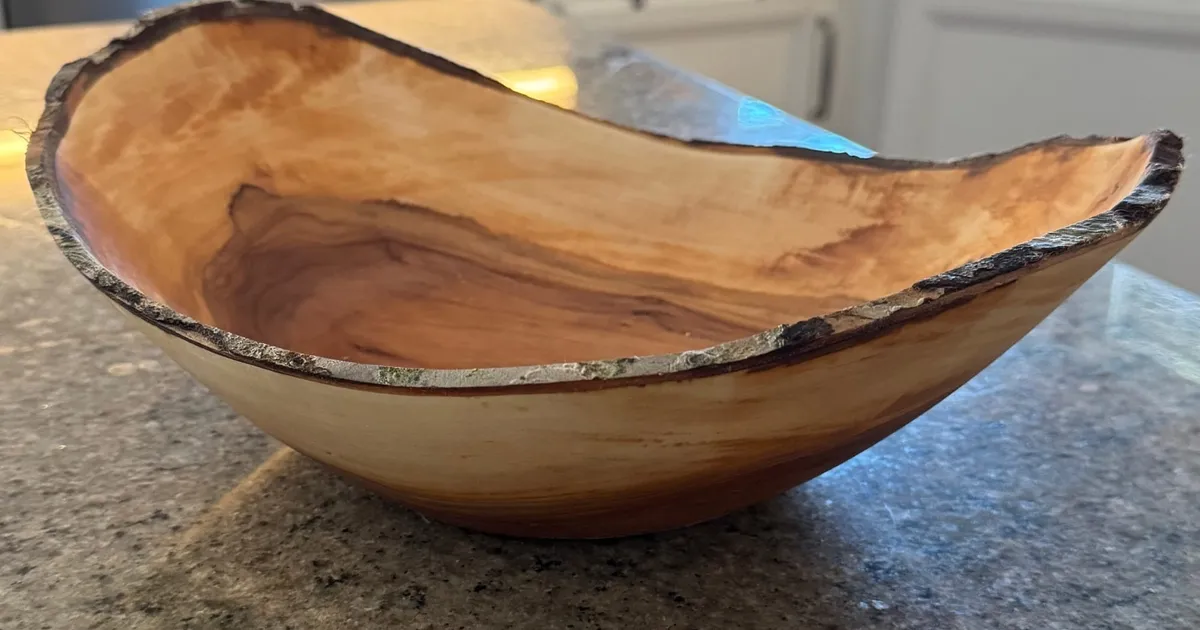
Hand-Turned vs. Factory Bowl: What's Actually Different
If you’ve ever held a hand-turned bowl and a mass-produced one in the same moment, you probably felt the difference before you could name it. One has a quality you notice in your hands. The other is fine, serviceable, but somehow anonymous.
Here’s what’s actually happening in that comparison — the specific, physical differences that explain why the two objects feel so different.
The Wood
Factory bowls are typically made from plantation-grown commodity species: acacia, mango, rubberwood, or teak. These are fast-growing woods chosen for consistency, availability, and low cost. They’re not bad woods — acacia in particular is genuinely durable — but they’re selected for their supply chain properties, not for beauty or character. The grain is predictable because it’s meant to be.
Hand-turned bowls use domestically grown or carefully sourced hardwoods: cherry, walnut, maple, ash, and more unusual species when they come available. These trees grow slowly. A black walnut that produces a beautiful bowl blank might be 60–80 years old. The grain patterns in those woods — the subtle curl in cherry, the dramatic spalting in soft maple, the architectural ring structure in ash — are the result of decades of growth, not days in a plantation.
More importantly: a hand-turner often knows exactly where a blank came from. I’ve turned cherry from a tree that came down in a neighbor’s yard, apple wood from an old orchard being cleared, cedar from a local tree service. That provenance is part of what you’re holding.
The Wall Thickness
This is one of the most tangible differences and one of the easiest to test.
Factory bowls are made by machines optimized for throughput. Wall thickness tends to be conservative — thicker walls are safer to produce at scale and reduce breakage during shipping. A typical import bowl might have walls 3/8” to 1/2” thick throughout.
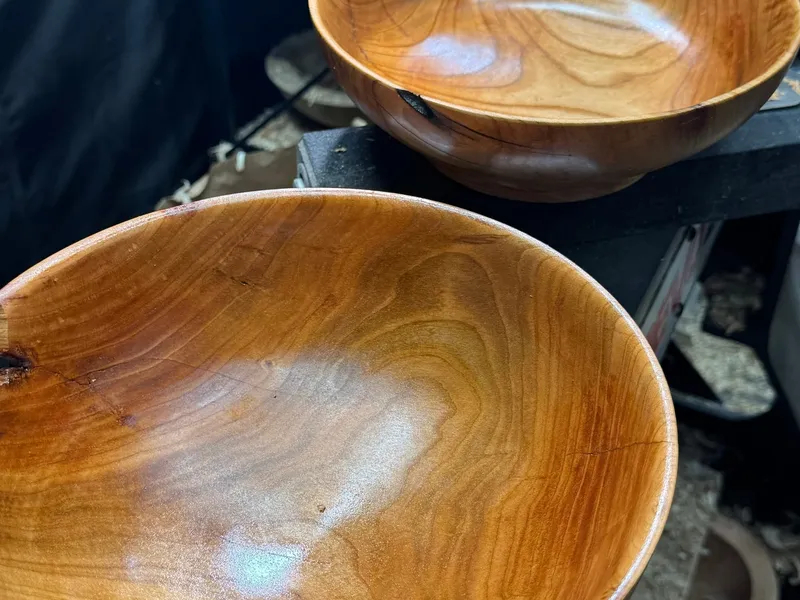
Hand-turned bowls — well-made ones — have walls that taper with intention. The rim might be 3/16” or thinner. The transition from sidewall to base has a deliberate curve, not a mechanical radius. Turn a hand-turned bowl over and run your finger along the outside: you should feel the wall thickness vary in a way that reflects a person making decisions, not a machine making parts.
A useful test: hold the bowl up to a light source and look through the wall. On a thin-walled piece in cherry or maple, you’ll often see the light transmit through the wood. It’s subtle and striking. A thick factory bowl won’t do this.
The Grain Orientation
Factory bowls are almost always face-grain or flat-sawn, with the growth rings running roughly parallel to the bowl’s rim. This is the most efficient way to cut blanks from a log and it produces consistent results.
Hand-turned bowls may be end-grain, side-grain, or oriented to take advantage of specific figure in the blank. The orientation of the grain relative to the bowl form affects both how it looks (figure reads differently at different orientations) and how it moves as it ages. A turner who’s paying attention to the blank chooses the orientation for aesthetic reasons — where will the figure be most visible, where will the grain wrap the curve most beautifully — not just for yield.
The Finish
Factory bowl finishes are applied by spray or dip in a production environment. They’re typically light mineral oil, food-grade wax, or a quick-drying lacquer. These protect adequately for light use, but they’re optimized for application speed and shelf stability, not for depth or longevity.
Hand-finished bowls — the ones made by turners who care about the work — use penetrating oils applied by hand in multiple coats, with drying time between each. Polymerized tung oil, Tried & True Varnish Oil, Rubio Monocoat, Osmo PolyX: these finishes bond with the wood fiber, build depth over multiple applications, and are designed for decades of use rather than years. They feel different in your hands — not slick, not plasticky, but like wood that’s been looked after. Our finishes guide explains each one in detail.
The practical difference: a penetrating oil finish can be refreshed. When it starts to look worn, a light sand and a fresh coat of oil restores it. A spray lacquer finish, when it wears, typically has to be stripped entirely.
The Form
Factory bowls are symmetric because that’s what machines produce. Every curve is the result of a programmed radius, and every bowl in the run is identical.
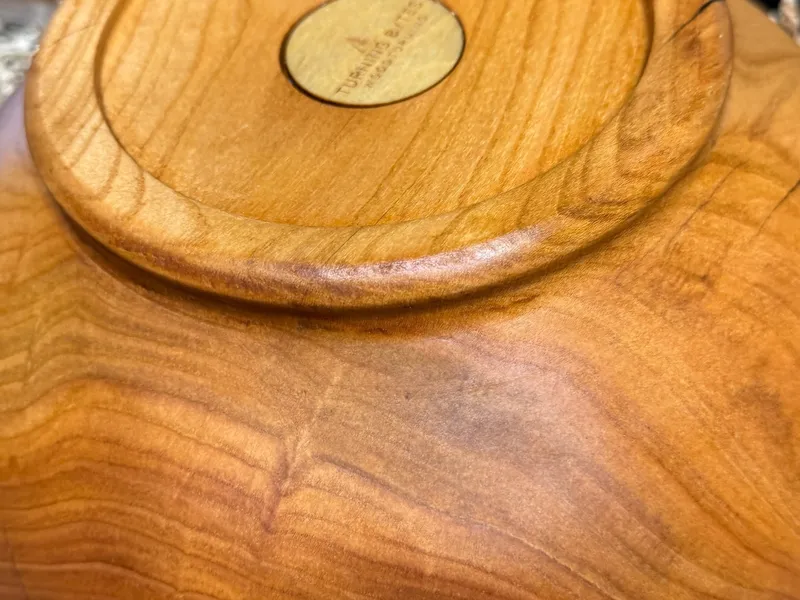
Hand-turned bowls are also symmetric in the structural sense — the lathe ensures that — but they’re not identical to any other bowl. The decisions a turner makes about rim width, foot design, wall curve, and overall proportion are made once, for this blank, on this day. Two bowls from consecutive blanks off the same log will be slightly different. That’s not a defect; it’s what handmade means.
None of this is to say factory bowls have no place. A $20 salad bowl that you’re not precious about has its uses. But when you’re choosing a piece you want to use daily for twenty years, or give as a gift that means something, the differences above are real and worth understanding. You’re not paying for a story. You’re paying for specific choices, made by a specific person, that you can see and feel in the object itself.
Interested in a custom piece with similar character?
I take a limited number of commissions each month to ensure every piece receives the attention it deserves. Let's discuss your custom commission