What Is Polymerized Tung Oil? A Wood Turner Explains
When you’re working with spalted wood, you’re working with a collaboration between nature and the craftsman. Spalting—the colorful zoning caused by fungi during the decay process—creates some of the most dramatic patterns found in any species of wood. But as any turner knows, the real magic doesn’t happen on the lathe; it happens during the finishing process.
The short version: Polymerized tung oil (PTO) is tung oil that’s been heat-treated to cure in days instead of weeks. It sinks into the wood rather than sitting on top, which means the grain stays visible and tactile. For spalted maple, birch, or any high-contrast wood, it makes the dark zone lines pop while warming the lighter areas — no plastic look, no cloudy film, just the wood at its best.
The Challenge of Spalting
The high contrast of spalted maple or birch can easily be overwhelmed by the wrong finish. A heavy film finish, like a thick polyurethane or lacquer, can create a “plastic” look that sits on top of the wood, masking the organic depth and killing the tactile experience that makes handmade woodenware so special.
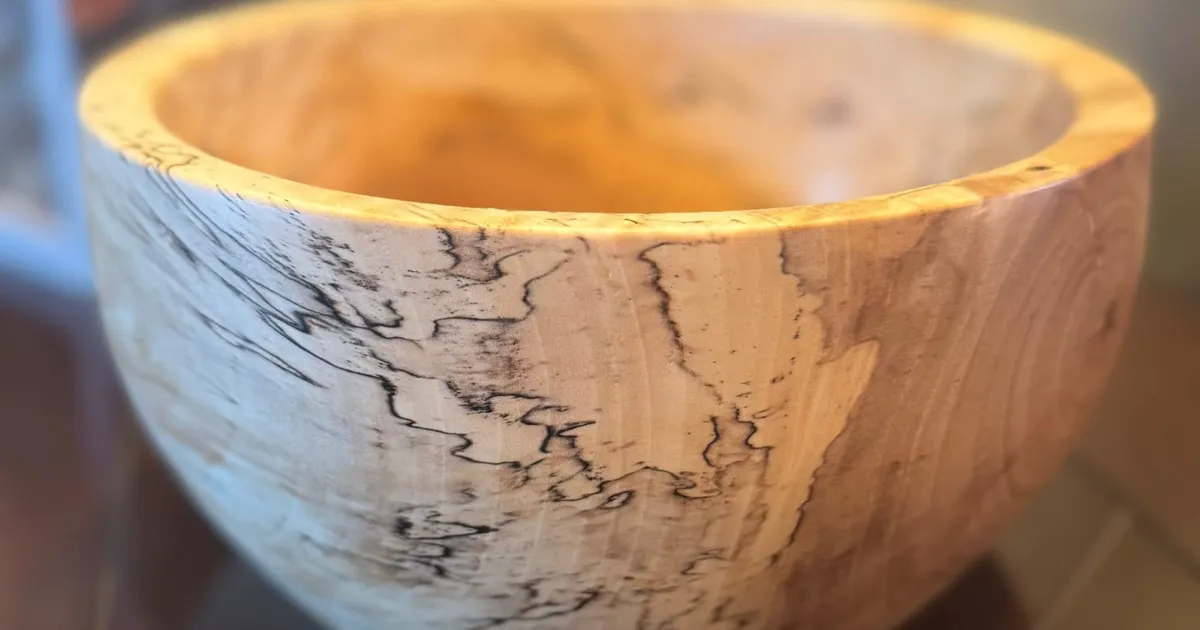
This vase was finished with four coats of polymerized tung oil and then buffed with carnauba wax.
What Is Polymerized Tung Oil?
Polymerized tung oil is pure tung oil that’s been heat-treated in an oxygen-free environment. That heat treatment pre-polymerizes the oil molecules — meaning some of the chemical crosslinking that normally happens during curing has already occurred. The result: the oil still penetrates wood deeply and cures to the same food-safe finish as raw tung oil, but it does so in 3–7 days instead of the 2–4 weeks raw tung oil requires. No solvents, no chemical dryers — just accelerated chemistry.
“Tung oil finish” is not polymerized tung oil. Products sold as “tung oil finish” at hardware stores typically contain very little actual tung oil — usually a blend of mineral spirits, varnish, and linseed oil. They are not food-safe. Pure polymerized tung oil lists “100% pure tung oil” on the label. These are completely different products.
Why Polymerized Tung Oil for Spalted Wood?
For my latest vase, I chose Polymerized Tung Oil (PTO). Unlike standard tung oil, which can take weeks to cure, polymerized oil is heat-treated to accelerate the drying process without sacrificing the finish’s characteristics. Here is why it’s my favorite for high-contrast pieces:
- Saturation: It sinks deep into the wood fibers, causing the creamy tones to warm up and the black spalted lines to “pop” with an intensity that surface finishes can’t match.
- Tactile Feel: It preserves the natural feel of the wood. When you run your hand over the piece, you feel the grain, not a layer of plastic.
- Satin Glow: Instead of a harsh, reflective mirror shine, PTO provides a sophisticated satin glow that highlights the form and the figure of the wood equally.
The Process
Applying the finish is a meditative part of the craft. After sanding the piece to a high grit, the first coat of polymerized tung oil is applied. The transformation is instantaneous—the “wet-out” reveals the true character of the piece, turning a dry, matte surface into a vibrant work of art. You wipe off any excess after 10-15 minutes. After 24 hours, I lightly sand with 600 grit sandpaper and wipe off any excess with denatured alcohol. I apply another coat the same way, wiping off excess after 10-15 minutes. I usually do 3-4 coats to bring out the matte sheen that I love.
How PTO Compares to Other Finishes
| Finish | Cure Time | Look | Best For |
|---|---|---|---|
| Polymerized Tung Oil | 3–7 days | Satin glow, grain-deep | Spalted, figured, high-contrast wood |
| Standard Tung Oil | 2–4 weeks | Similar, but impractical for production | Purists willing to wait |
| Osmo Polyx-Oil | 24 hours | Consistent sheen, plant-based | Faster turnaround, near-flat surfaces |
| Ack’s Abrasive Paste + Carnauba | Lathe-applied | High gloss, wax surface | On-lathe finishing, pens, smaller forms |
| Polyurethane | 24 hours | Glossy film, plastic-like surface | High-wear furniture, not bowls |
| Danish Oil | 24–48 hours | Soft sheen, less durable | General turning, less demanding grain |
| Rubio Monocoat | 24 hours | Matte, modern | Ebonized/pigmented work, flat surfaces |
I’ve used all of these at one point or another. For the spalted pieces especially, nothing else comes close to what PTO does. The grain-deep saturation is what separates it — poly and Danish oil sit on the surface. Rubio looks great on tabletops and ebonized work, but doesn’t have the same three-dimensional depth on a curved turned surface. Osmo Polyx is a useful middle ground when I need a food-safe result in 24 hours. Ack’s is its own category — a tripoli abrasive paste followed by carnauba wax, applied on the lathe, that gives a high-gloss surface without building a film. And standard tung oil works beautifully, but waiting three weeks between coats doesn’t work when you’re making pieces to sell.
Frequently Asked Questions
What is polymerized tung oil?
Polymerized tung oil is pure tung oil that’s been heat-treated in an oxygen-free environment. This process pre-polymerizes the oil molecules, which dramatically speeds up the cure time — from the 2–4 weeks raw tung oil takes down to 3–7 days — without adding chemical dryers or solvents. The result is still 100% tung oil, just faster-curing and slightly more durable.
What’s the difference between tung oil and polymerized tung oil?
The difference is cure time and durability. Standard tung oil takes 2–4 weeks to fully cure between coats and produces a softer finish. Polymerized tung oil cures in 3–7 days and creates a harder, more water-resistant surface. Both are food-safe once cured. For production turning work, PTO is the practical choice; for a personal project with no deadline, standard tung oil works fine.
Is polymerized tung oil food-safe?
Yes, once fully cured. Pure tung oil (including polymerized) is FDA food-safe. I cure my pieces for a minimum of 30 days before they leave the shop to ensure the finish is completely inert. Avoid products labeled “tung oil finish” — those often contain solvents and metallic dryers and are not food-safe. Look for 100% pure polymerized tung oil.
How many coats of polymerized tung oil do I need?
I apply 3–4 coats for most pieces. After sanding to a high grit, the first coat goes on heavy, sits for 10–15 minutes, then excess is wiped off. After 24 hours, I lightly sand with 600 grit, wipe with denatured alcohol, and apply the next coat the same way. Each coat builds depth. By coat four, the grain has a satin glow that doesn’t read as “finished” — it just looks like the wood at its absolute best.
Why use polymerized tung oil instead of polyurethane?
Polyurethane sits on top of the wood in a film. PTO sinks in. On spalted or figured wood, film finishes flatten the visual depth — you lose the three-dimensional quality of the grain. PTO preserves it. Plus, on a turned bowl or vase, a poly finish feels like plastic. PTO feels like wood.
Explore More
Polymerized tung oil works so well on spalted wood partly because of what spalting actually is. What is Spalted Wood? → explains the fungal process that creates those dramatic zone lines.
For a full comparison of finishes — tung oil, Rubio, Osmo, Waterlox — see Wood Bowl Finishes Explained →
Browse maple → and birch → turning projects to see this finish in action.
Interested in a custom piece with similar character?
I take a limited number of commissions each month to ensure every piece receives the attention it deserves. Let's discuss your custom commission